SOC 2 Type II certification in progress.
Deployed to your own cloud tenant or your own infrastructure. Nothing leaves your environment.
Bring the model you trust and swap it whenever you need to. Compute and tokens run on your account, not ours.
Extensible via MCP, an open standard, so the platform connects to what you already run instead of replacing it.
No lock-in, no dependency, no proprietary format. What you build stays yours.
Detect where policy and practice diverge - across contradictions, absences, drift and conflicts. Left Right Mind runs four intelligence agents on one unified platform, turning every gap into a governed, traceable, agentic workflow.
Your policy says one thing. Your operations show another. Detect surfaces the exact record, the governing clause, and the calculated exposure - without manual cross-referencing.


The data doesn’t show the wrong thing - it shows nothing at all. Detect cross-references required actions against systems of record and treats silence as a signal.
No single period broke the rule. The trajectory did. Detect looks across periods to catch directional decay before a hard threshold is crossed.


The data isn’t the problem - your documents disagree with each other. Detect finds where global SOPs, regional addenda, and local procedures contradict, before an auditor does.
Every exception surfaced by Detect can be dispatched as a governed workflow - source evidence attached, accountability assigned, and a full audit trail from trigger to closure.
Findings don’t just sit on a dashboard. Resolve routes each exception to the right owner with the document clause and data evidence already in the packet - no copy-paste, no lost context.
Individual accountability, fully traceable. Each task carries its triggering clause, the data behind it, and clear resolution criteria, so reviewers always know what changed, why and on whose authority.
Multi-step orchestration with full audit. Approvals, escalations, and re-assignments are captured as a continuous Decision Trail, ready for inspection at any point in the process.
Banking, pharma, manufacturing, construction, procurement, public sector. Different language, same problem: closing the gap between policy and practice. A selection of the workflows we’ve built, deployed, and handed over.
Interrogate your documents and data through natural language. Explore synthesizes across sources and delivers cited, traceable answers - turning a single question into a complete, auditable picture.
Ask in plain language and get back a synthesized answer, not a list of links. E understands intent, scope & follow-ups across running threads.
Every sentence links to its source - page, paragraph, cell, or clause. Auditors and reviewers can verify claims without leaving the answer.
Pull from contracts, SOPs, tickets, lab reports, and tables in a single response. Explore reconciles conflicts and flags where evidence is thin.
Tables, scans, stamps, and signatures - parsed and queryable. Explore reads what your teams actually file, not just clean text.
Permissioned by user, logged by query, reproducible by design. Every answer is exportable as an evidence pack ready for review.
Explore ships pre-tuned for your domain - clinical, contracts, claims, or compliance with your sources connected and your guardrails in place.
* Subject to process & workflow complexity.
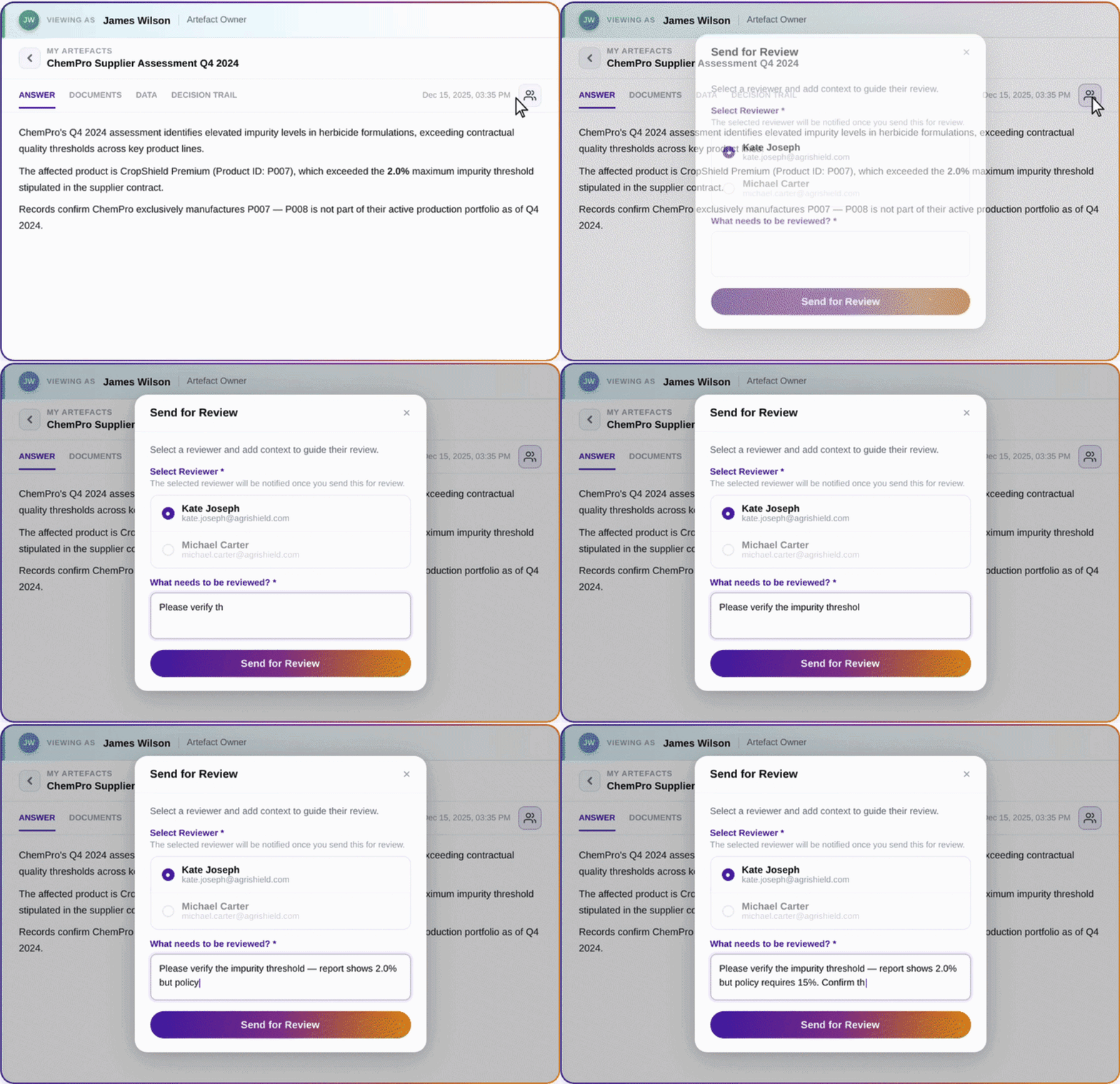
Every response is explainable and fully traceable, with a built-in Human-In-The-Loop (HITL) engine that keeps people in control; delivering responses you can trust, scale, and measure.
Every response traceable to its source document or data query.
Approval queues sized for SMEs, not swamped with noise.
Dispatches can be retracted, amended, or escalated.
Immutable log of who approved what, when, & with evidence.

Custom use-case agents that learn your workflows, rules, approval processes, operating methods, and definitions.
Designed to adapt to your business, not the other way around.
How many distinct inference steps the agent performs from trigger to output.
How many human roles are involved, and how they interact.
What the agent produces at the end of its run.
What systems the agent writes to or triggers.
What’s required to know the agent is performing correctly.